Public observation context
Original report · Exact report snapshot
- Product
- NIVEA
- Observation language
- en-US
- Region
- Hong Kong
- Buyer questions
- 4
- Recorded narrative answers
- 12
- Completed narrative answers
- 12
- Supporting searches
- 4
- Full narrative observation period (UTC)
- 2026-10-19T19:16:27.244Z — 2026-10-19T19:17:52.531Z
- Narrative count by date (UTC)
- 2026-10-19: 12
- Report generated
- 2026-10-20T02:51:41.125Z
- Website source captured
- 2026-10-20T02:48:29.236Z
- Narrative models
- chatgpt: openai/gpt-6-luna; claude: anthropic/claude-haiku-5.5; gemini: google/gemini-3.7-flash
Original observation witnesses
The content-versus-cleanup question is really a sequencing decision
A local client may ask whether the next budget should go to another AI-focused content push or to cleaning up its business information. Treat that as a sequencing decision, not a contest between GEO and good content.
A useful service page can explain what the business does, who it serves and what makes an option a fit. But if a person or search experience encounters conflicting opening hours, an unclear address or an outdated contact route, more copy does not resolve that basic uncertainty. Conversely, a perfectly maintained profile does not answer every question about services, suitability or the customer’s choices. These jobs support different parts of discovery and decision-making.
The practical first move is to check whether the facts a customer needs to find, contact or visit the business are current and consistent across the places that matter. Then ask whether the proposed content would answer a distinct, real customer question. For clients serving multiple markets, also check that the page reached from a local profile actually serves the intended market. A domain or location label alone does not establish that the destination content is locally relevant. The order should follow the gap you can actually see, not the excitement of the label AI optimization.
Sources: AI Performance in Bing Webmaster Tools; Optimizing your website for generative AI features
Start with the facts that help someone find or contact the business
Begin with the basics that can change a customer’s next action. Bing specifically highlights keeping address, hours and contact information current for local business information that may be eligible for inclusion in AI-generated responses. Google’s guidance says Business Profiles can help make local-business information available in AI responses and other Google Search results. Neither point turns a profile into a guarantee of visibility. They do make a basic information review a sensible part of local campaign maintenance.
For each location or business profile in scope, check the following facts against an authoritative source supplied or confirmed by the client:
Business name: Is the name recognizable and represented consistently where the business is listed?
Physical location or service area: Does the location information reflect how this business actually serves customers? For a business customers visit, verify the address. For a service-area business, confirm the areas it genuinely covers rather than implying a walk-in location that does not exist.
Opening hours: Are the ordinary hours current? Check known temporary closures, seasonal schedules or special hours where the profile supports them, and confirm who will update them when plans change.
Contact route: Does the listed phone number or other offered contact method reach the right team? Is the destination still monitored?
Website destination: Does the profile send people to a current page that explains the relevant location or service, rather than to a dead or misleading destination?
Services or business details: Do the visible details describe what the location actually offers, without implying unavailable services?
This is a practical agency audit, not a claim that every platform has identical fields or that every detail carries equal weight in its systems. Keep recommendations platform-specific: review the client’s Google Business Profile in the Google context and use Bing Places for Business for the corresponding Bing presence. Confirm the available fields and the client’s operating model before changing them.
Sources: AI Performance in Bing Webmaster Tools; Optimizing your website for generative AI features; AI features and your website; Introducing the New Bing Places for Business: Built for Business Owners, Powered by Research; NIVEA: public website context
Accuracy matters because it reduces uncertainty, not because it unlocks a mention
A local query often depends on concrete facts: where a business is, when it is open and how a customer can reach it. If those facts are stale or conflict across the surfaces a customer checks, the business becomes harder to assess and act on. Keeping relevant profiles current is therefore a straightforward way to make essential information available and reduce avoidable confusion.
There is also a platform-specific discovery rationale. Bing says current key details can help local businesses remain eligible for inclusion in AI-generated responses. Google says Business Profiles can help local-business details be visible in AI responses and other Search results, while its broader AI guidance emphasizes foundational SEO and useful, reliable content rather than a separate set of AI-specific optimization requirements. Read these as reasons to maintain the business’s information within the relevant platform, not as a recipe that makes an AI choose the business.
Accuracy is a maintenance condition, not a visibility promise. A listing being complete, a fact being consistent, or a profile being eligible does not guarantee a citation, an AI recommendation, a position in search, or a customer conversion. The practical value remains even when no AI answer mentions the business: a person who finds the profile can use accurate details to decide whether to call, visit or continue researching.
Sources: AI Performance in Bing Webmaster Tools; Optimizing your website for generative AI features; AI features and your website
Prioritize corrections by customer consequence and confidence
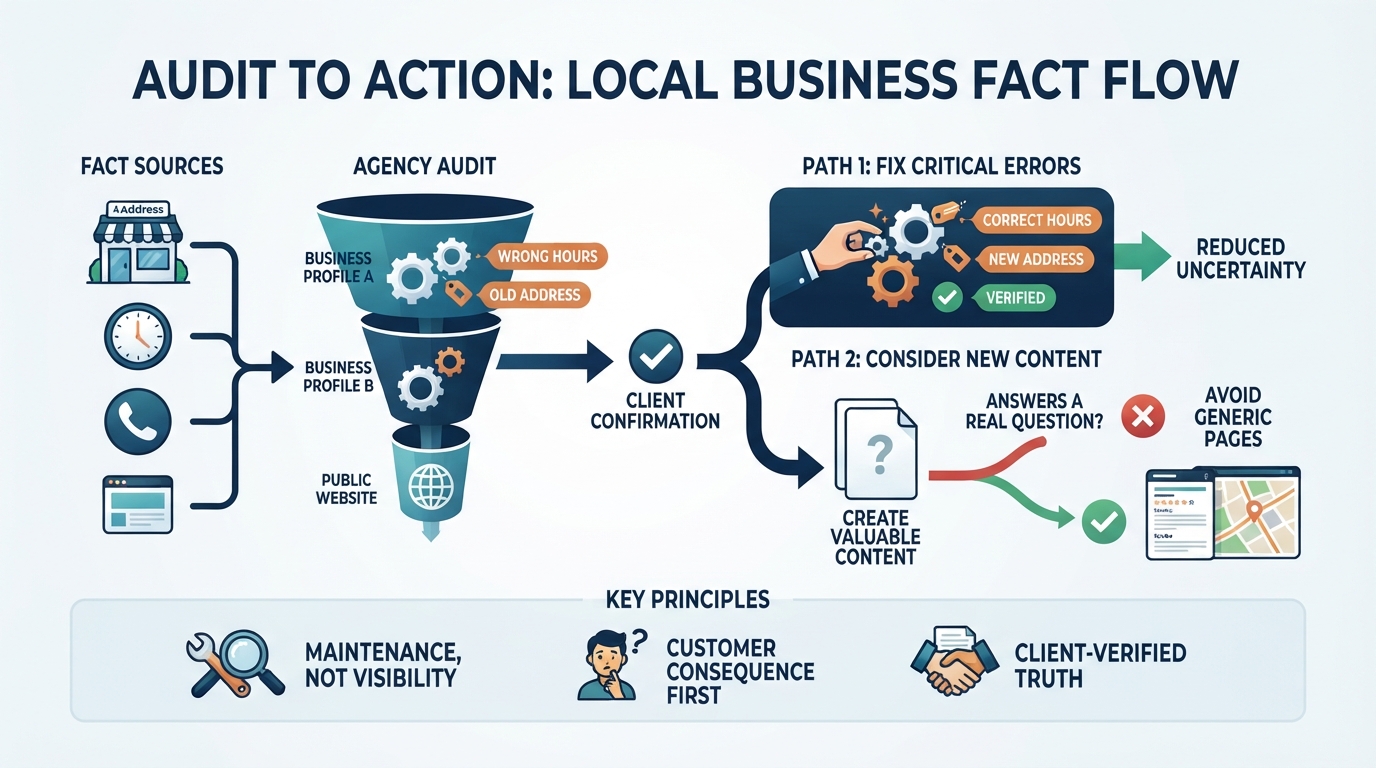
An audit is only useful if it leads to a manageable queue of work. Sort discrepancies by two questions: could this fact misdirect or inconvenience a customer, and can the client confirm the right answer? That keeps a location or opening-hours problem ahead of cosmetic profile polishing, while avoiding guesses about information the agency cannot verify.
A practical order is:
Fix customer-critical errors first. Prioritize a wrong address, misleading service-area information, incorrect hours, a disconnected contact method or a destination that no longer explains the business. Confirm each correction with the client before publishing it.
Resolve inconsistencies across the surfaces that matter. Compare the relevant business profiles with the client’s own current website and operating information. Identify which version is authoritative, then bring the managed surfaces into line. Do not silently choose between conflicting facts.
Clarify details that affect fit. Once the basics are dependable, check whether customers can understand the services offered at that location and any meaningful limits. Correct misleading detail; add useful explanation on a page if it answers a genuine question.
Put the facts under an owner. Record who at the client’s business approves changes, who has access to the profiles and who is responsible for hours or contact updates when operations change. A one-time cleanup without an update owner tends to age.
This prioritization is an agency workflow, not a platform ranking formula. It helps explain why an operational correction may be a better immediate use of budget than creating several near-duplicate location pages. It also leaves room to fund content when the facts are already reliable and there is a real unanswered customer need.
Sources: AI Performance in Bing Webmaster Tools; Optimizing your website for generative AI features; Introducing the New Bing Places for Business: Built for Business Owners, Powered by Research; NIVEA: public website context
A hypothetical client decision: correct the hours before commissioning more pages
Imagine a local business with outdated opening hours in a relevant profile and a budget set aside for new location pages. The agency confirms with the client that the listed hours are wrong, corrects the managed profile information and checks whether the same error appears on the public website. If the client confirms that the hours differ by location, the site should make that distinction clear rather than repeat one generic schedule across every page.
In this hypothetical, the correction should come first: it fixes a known fact that can affect whether a customer visits at the right time. The planned pages should not be cancelled by default. Before commissioning them, decide whether each would serve a distinct local audience or answer a meaningful question, such as which services are available at that location. If the proposed pages would merely restate the same address and generic sales copy, resolve the information issue and rethink the brief instead.
This example illustrates a prioritization choice; it does not report a measured outcome, and it does not predict that any AI experience will mention the business after the correction. The defensible client recommendation is narrower and more useful: correct verified, customer-facing facts first, then spend on content that adds real local value.
Sources: AI Performance in Bing Webmaster Tools; Optimizing your website for generative AI features
Turn the audit into a clear client action and reporting story
Make the review easy to approve and maintain. For each issue, record the fact in question, where it appears, the client-confirmed correct version, the action owner and whether the change has been made. Keep a distinction between verified corrections and items awaiting client confirmation. That prevents a tidy-looking profile from concealing an unresolved business decision.
A useful client handoff can include:
A short list of the highest-impact mismatches, with the specific customer consequence.
The client-approved source of truth for each fact, especially where locations or operating hours differ.
The profiles or pages the agency will update, and any areas that require client access or approval.
A named person responsible for future hours, contact and location changes.
A separate content brief for questions the profile cannot answer, including why that information helps a customer decide.
Report the work as maintenance and information quality: what was checked, what the client confirmed, what changed, and what remains open. If the client also wants to monitor AI visibility, keep that observation separate from the correction log. Where available, Google Search Console’s Generative AI performance report and Bing Webmaster Tools’ AI Performance can provide site-level visibility or citation signals. Be precise about what each reports: Google’s report concerns site content in its generative AI features; Bing’s AI Performance reports citations and cited URLs across supported AI experiences, not a local profile’s visibility or the effect of a profile correction. Treat these as separate observations, not measures of the effect of a particular profile correction or of customer leads. For manual answer checks, record the exact question, location or service area, platform, date and answer so later observations can be compared on the same basis. A mention or recommendation does not establish that a profile update caused it, and no mention does not show that the correction failed.
The sensible next step is not automatically another AI campaign or a broad profile overhaul. It is the smallest verified action that removes a customer-facing information problem. Once those facts are dependable, invest in content when it has a distinct job: explaining service fit, answering a local question or helping a buyer make a better-informed choice.
Sources: AI Performance in Bing Webmaster Tools; Optimizing your website for generative AI features; AI features and your website; Introducing the New Bing Places for Business: Built for Business Owners, Powered by Research
Sources
- AI Performance in Bing Webmaster ToolsMicrosoft Bing · Accessed Explore publications using this source
- Optimizing your website for generative AI featuresGoogle Search Central · Accessed Explore publications using this source
- AI features and your websiteGoogle Search Central · Accessed Explore publications using this source
- Introducing the New Bing Places for Business: Built for Business Owners, Powered by ResearchBing Search · Accessed Explore publications using this source
- NIVEA: public website contextwww.nivea.com.hk · Accessed Explore publications using this source