What is the difference between GEO, AEO and SEO?
SEO helps people discover useful pages through search. AEO focuses on answering their questions clearly. GEO focuses on how a business or source appears in generated answers. These jobs overlap: an AI answer can retrieve a searchable page, use part of its explanation and cite it. Start with the customer’s question, publish a useful answer and make its supporting information accessible.
Three lenses for the same customer journey
A buyer may move from a search result to an AI summary, then open a source to decide whether a product fits. Plan for that whole journey. The terms help when they clarify the job of a page; treating one page as three unrelated optimisation projects can obscure the reader’s actual need.
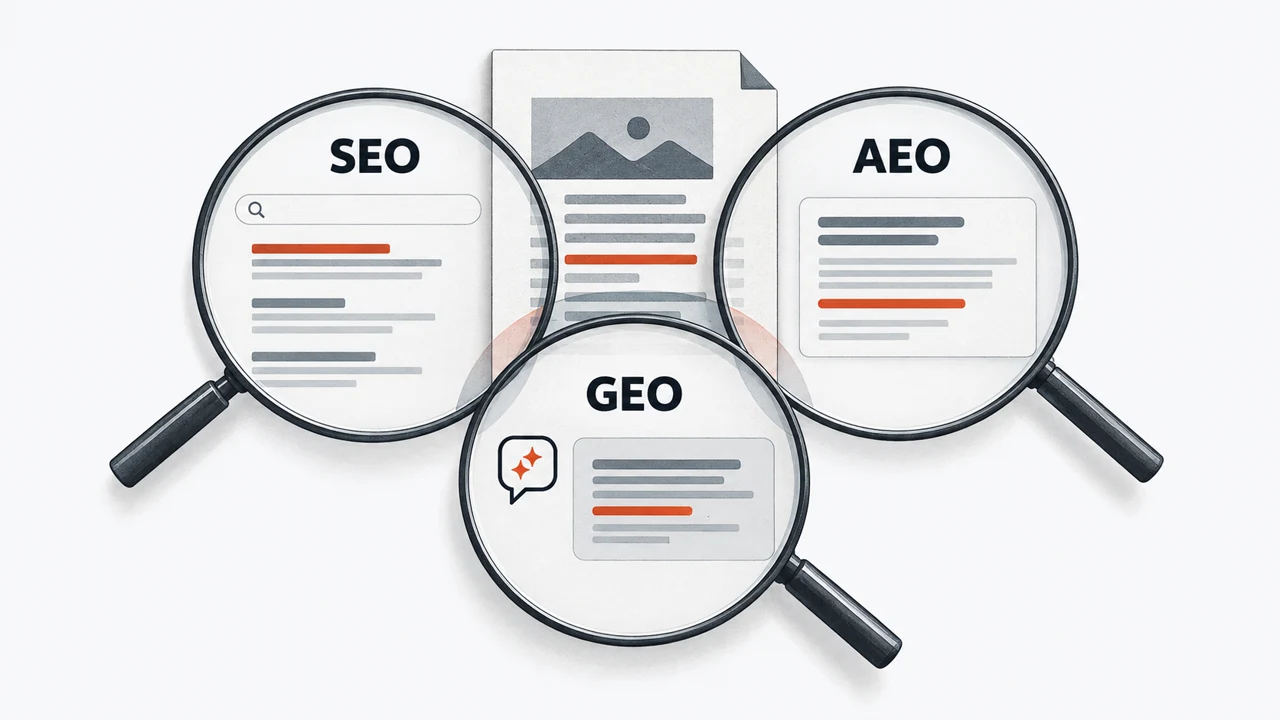
Choose the reader’s job before the optimisation label
Scroll to read all columns.
| Lens | Reader’s need | Useful page output |
|---|---|---|
| SEO | Find a relevant page | A discoverable page with a clear subject and useful detail. |
| AEO | Resolve a question | A direct answer and the explanation needed to use it. |
| GEO | Understand or choose through an AI answer | Clear product facts, evidence and context an answer can draw on. |
What Google’s guidance changes
Google keeps foundational SEO relevant to its AI-search features. Its generated answers use retrieved information and may expand a question into related searches. The publisher’s priority is original, useful content on an accessible site. Google says no special AI file or schema is required. Maintain machine formats for their readers and write the page for the person who arrives.
Sources: Optimizing your website for generative AI features; AI features and your website
Build around a decision
A category definition alone rarely helps a buyer choose. Explain who the product is for, the job it solves, the conditions under which it fits and the evidence behind material claims. A source link should let the reader inspect relevant support. The page should then offer a sensible next step.
Name the real need
Use wording a customer might use before knowing your brand. Include team size, location, an existing tool or a required outcome when it affects the decision.
Give a usable answer
Place the conclusion near the top. Explain the trade-offs and conditions that change it in the body.
Make the next step concrete
Link to a relevant product detail, worked example, comparison or source so the reader can act on what they learned.
Sources: Buyer questions for AI visibility; How Ready Scan builds an AI visibility scorecard
A worked content decision
Consider a hypothetical bike-repair business explaining same-day servicing. A page saying “Why choose us?” may leave the buyer’s questions unanswered. One substantial service page could explain which repairs can usually be completed in a visit, how inspection affects the estimate, when parts must be ordered and how to book. This is a content example, not a measured AI result. Its value comes from accurate business information that helps a real decision.
Sources: Optimizing your website for generative AI features; Buyer questions for AI visibility
Keep one useful answer current
Give each distinct reader need a canonical home. Add meaningful detail there when the evidence changes. If a related topic deserves a separate page, link the two in context and explain what the second page helps the reader decide. Many slightly different question variants should not fragment one coherent explanation.
Choose the next useful action
If the offering is unclear, improve its explanation. If useful detail is hard to reach, repair navigation and access. If a retained answer misstates the product, inspect its cited sources and correct information you control. The observed problem should determine the next action; the optimisation label cannot make that decision for you.
Sources: How Ready Scan builds an AI visibility scorecard; Buyer questions for AI visibility
Sources
- Optimizing your website for generative AI featuresGoogle Search Central · Accessed
- AI features and your websiteGoogle Search Central · Accessed
- How Ready Scan builds an AI visibility scorecardReady Scan · Accessed
- Buyer questions for AI visibilityReady Scan · Accessed
Read next
Start with the questions your buyers ask.
Ready Scan shows the answers behind brand mentions, citations and recommendations.
Check my brand